“Ninth graders across the country can recite the basic stages of the cell cycle—growth, DNA replication, division—but the world’s best researchers are still trying to figure out how the thing actually works.” (Burrows)
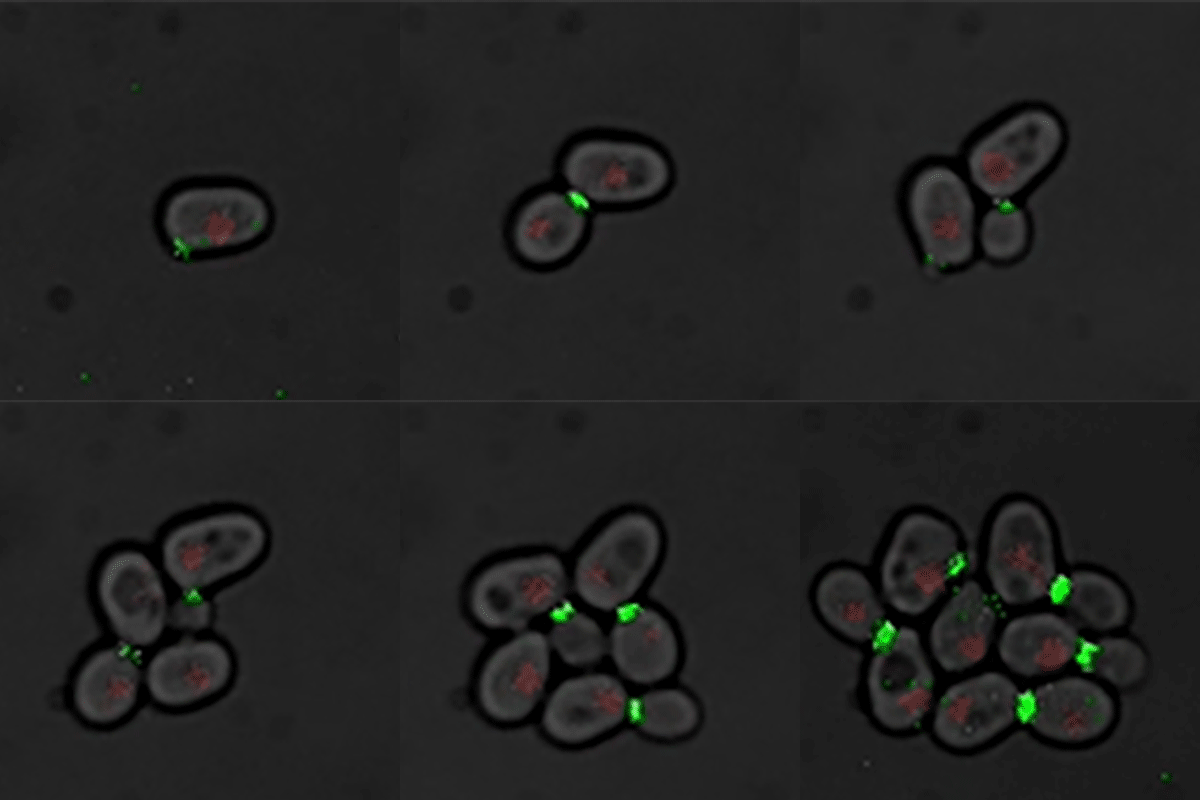
“In a new paper, Amir observes the same mechanism in budding yeast cells, suggesting that this process may be prevalent across different kingdoms of life. The paper is published in the journal Current Biology.” (Burrows)
In 2014, Ariel Amir, an assistant professor of applied mathematics, disproved a long-held belief that cellular division in bacteria is triggered when cells reach a particular size. Amir suggested that cells coordinate the replication of their DNA not through size but by how much they grow over time. (Burrows)
“The cycle begins at budding. When a mother cell buds, two gauges begin ticking in the daughter cell, one measuring time, the other volume added. Each gauge has a pre-programmed stopping point. When the timer runs out, the daughter cell knows its time to divide. When the right amount of volume is added, the daughter knows its time to bud. Every cell, regardless of its size at birth, adds the same amount of volume before budding and grows the same amount of time before division.” (Burrows)
“This is identical to what we see in bacteria,” Amir said. “This mechanism may have evolved as a robust way to coordinate the various events in the cell cycle – growth, division and DNA replication – using simple biological components.” (Burrows)
READ THE ARTICLE HERE: https://phys.org/news/2016-02-cell-bacteria-budding-yeast.html
New work sheds light on the structure of the cell cycle in bacteria and budding yeast
by Leah Burrows, Harvard University
Microbial cells are tiny living units that make up microorganisms — life forms too small to see with the naked eye. These include bacteria, fungi, protozoa, algae, and viruses.
Imagine them as the “LEGO blocks of tiny life.” They’re simple but powerful — and they’re everywhere: on your skin, in your gut, in the soil, in the ocean, and even floating in the air.
Looi explains that the human microbiome consists of around 39 trillion microbes living in and on the human body.
“Three-quarters of your microbiome can be traced back to your mother. The womb is a sterile place, free of microbes (at least we think so at the moment). But when we exit via the birth canal, we’re bathed in vaginal microbes.” (Looi)


 ZOA
ZOA 